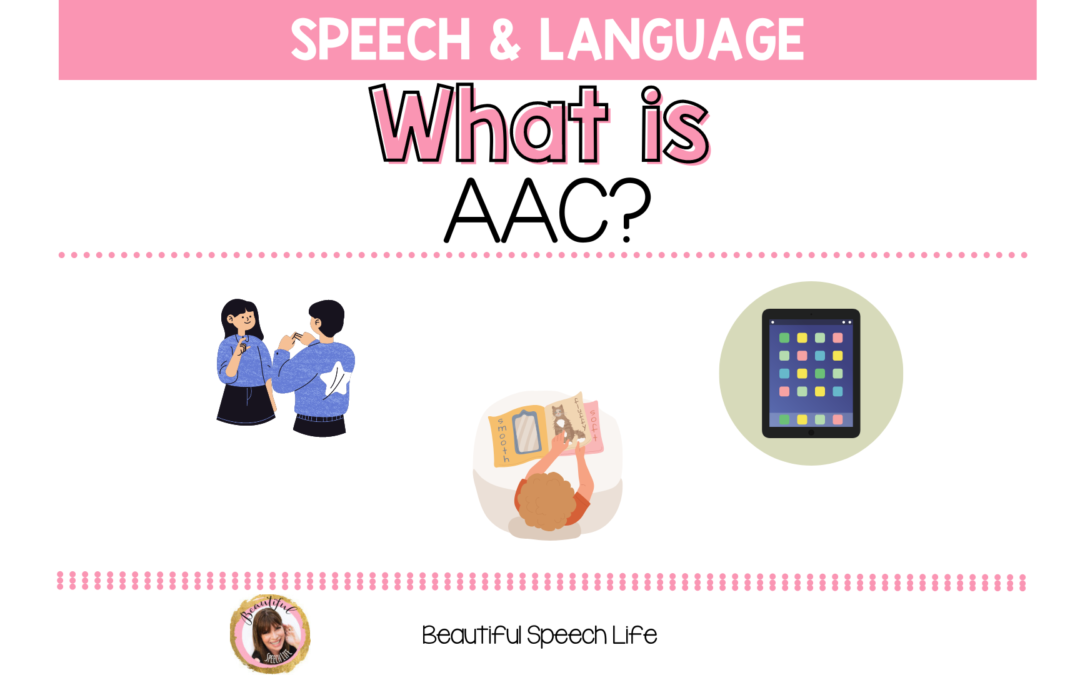
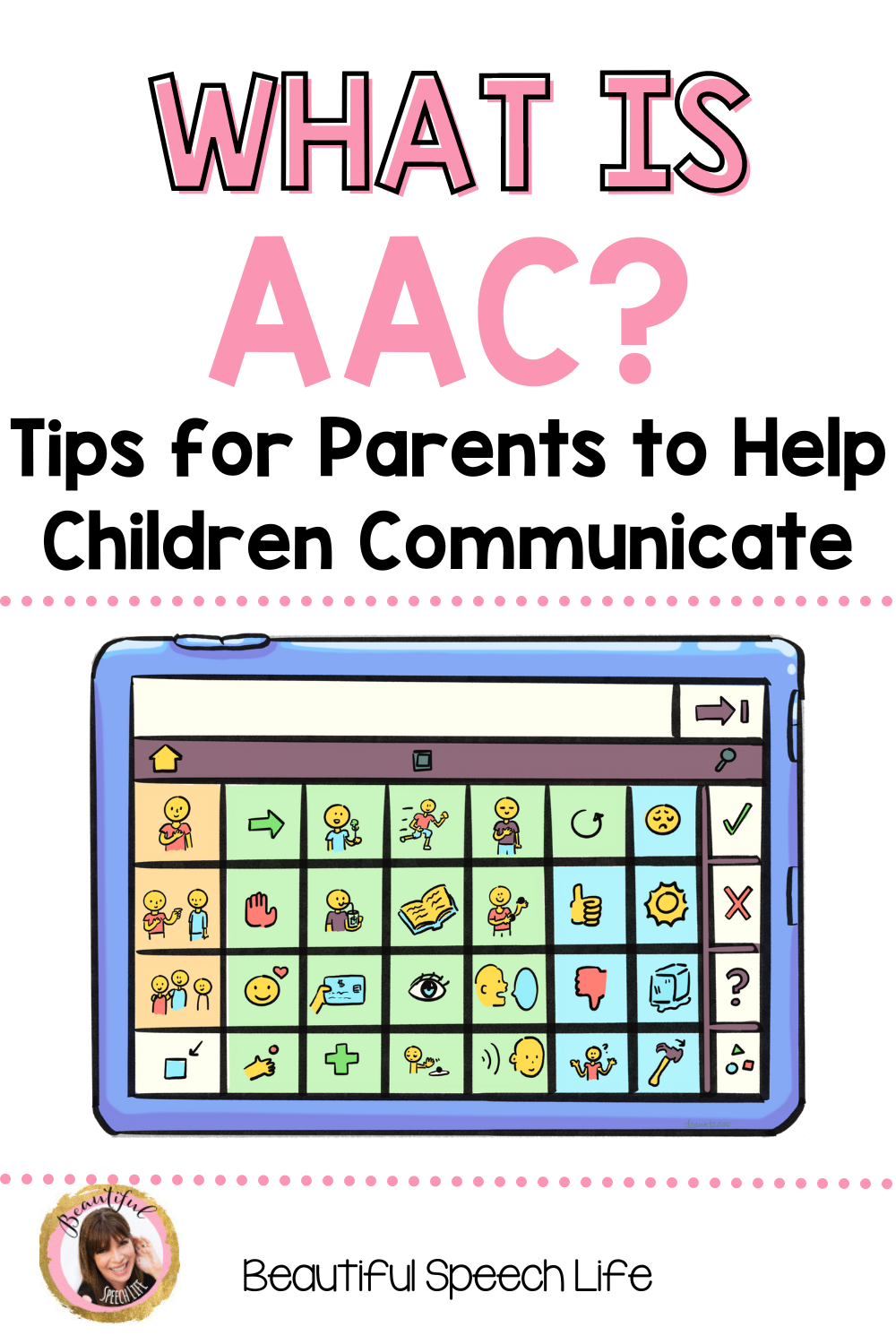
What is AAC? AAC stands for Augmentative and Alternative Communication. It refers to a range of methods and tools that can be used to augment or replace spoken communication for people who have difficulty speaking or expressing themselves.
Are you a parent considering AAC for your child? Maybe your pediatrician or speech language pathologist recommended having a look at AAC. But you feel hesitant because you don’t know much about it. Or maybe you’re worried that it will stop your child from talking. Let’s start with some basic facts and information about AAC and exactly what it is.
The first “A” in AAC is for augmentative. To augment is to increase or to add to. Augmentative communication is when you add something to your speech (eg. a core board for pointing or a speech generating device). This can make your message clearer to your listener.
The second “A” is for alternative. This is using an alternative to spoken voice to communicate. This is for individuals who cannot speak or who can speak but it’s very difficult to understand them. AAC will help others understand their message.
AAC can include things like gestures, sign language, communication boards or books with pictures or symbols, and assistive technology such as speech-generating devices or apps. It is used by people of all ages who have a wide variety of communication needs, including those with autism, cerebral palsy, Down syndrome, childhood apraxia of speech, developmental delays, stroke, and other conditions that can affect language development or production.
The goal of AAC is to enable individuals to communicate more effectively and participate more fully in their daily lives. Communication is a fundamental human right .
AAC allows people to communicate more fully.
There are many different types of Augmentative and Alternative Communication (AAC) tools and methods that can be used, depending on the needs and preferences of the individual. Here are a few examples:
Gestures: Simple hand gestures, such as waving or pointing, can be used to communicate basic messages.
Sign language: Formal sign languages, such as American Sign Language (ASL) or British Sign Language (BSL), can be used to communicate more complex messages.
Communication boards or books: These can include pictures or symbols that represent different words or concepts. The individual can point to the appropriate symbol to communicate their message.
Speech-generating devices (SGDs): These are electronic devices that allow the user to select pre-programmed words or phrases, or to type out messages using a keyboard or other input method. The device then speaks the message out loud.
Apps: There are many apps available for smartphones or tablets that can be used for AAC. These may include pre-programmed phrases or allow the user to type out messages, which are then spoken out loud or displayed on the screen.
While It’s important to note that there is no one-size-fits-all solution for AAC, the best approach will depend on the individual’s needs and abilities. It’s also important to build upon the communication skills each person already has.AAC is truly multimodal, permitting individuals to use every mode possible to communicate.
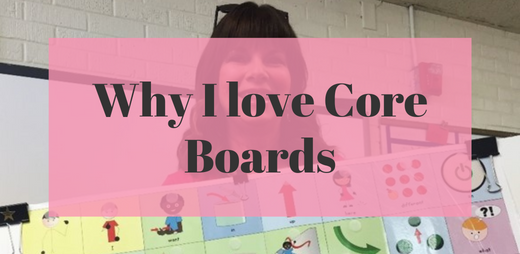
Technology and all the wonderful tech tools that are out there to help our students is amazing. But I’m not giving up my printed core boards any time soon.
🧡🧡🧡 I love core boards because:
They help make an abstract word visible by giving it a symbol and a location
Visuals can focus a student’s attention and help them filter out distractions
Many kids with disabilities have strong visual skills
They help give language visible structure and a visual pattern
It gives a visual foundation of frequently used words
They work
A big board is great for everyone in preschool classrooms, special education classrooms and in your speech rooms too.
If you are looking for help with core boards, then download your condensed guide to core boards here. You’ll find links to popular AAC boards, along with tips to get started.
During the pandemic I did a lot of walking in my neighborhood. What else was there to do?
Every time I walked by this one house on the corner there was such a beautiful fragrance in the air. One day the owner was outside and I asked him about it. He said his wife was magical with plants and had all sorts of jasmine growing in the back yard. 🌱🌱🌱
So I of course decided I needed some. I went to Lowe’s and bought a nice little jasmine shrub and Brad helped me plant it.
I watered it and waited for the flowers and the fragrance.
No flowers. No fragrance. And actually very little growth.
I kept watering and checking…watering and checking.
Nothing. But it did stay alive, it just basically looked the same.
A year went by.
No flowers.
I thought maybe I’m doing something wrong? Maybe I don’t have the right touch?
Almost another whole year goes by but at the end of March, I look and the plant has tripled in size with tons of shiny green leaves. 🌱🌱🌱😊
And now after 22 months my jasmine plant is flowering. 🎉🎉🎉
Lots of little star shaped blooms and they smell heavenly.
I feel like there’s an analogy here between this jasmine plant and working with AAC.
A student gets an AAC device and we expect greatness. But nothing happens.
What we forget is that things are happening beneath the surface!
Things that we can’t see and sometimes don’t understand.
Your student might be busy growing receptively or having a physical growth spurt.
The expressive piece, or the output, WILL happen but usually not on our timeline.
So while you are nurturing and giving him access would you like some extra tools to help?
I’ve got you covered.
Click here to download your free core word activity
This is for you if you want to build your confidence and begin the journey to empowered AAC modeling but need a few additional strategies, tips and tools. All you need to do is add bubbles!
iPad’s Guided Access feature for an Augmentative Alternative Communication (AAC) user is an important option. Guided Access limits an iPad to a single app and lets you control which features are available. If you have a young AAC user, most likely you will want him to only use the iPad as a communication device.
Especially when he’s first learning how to use AAC.
I can’t tell you how many times school staff or parents have let a student use the iPad to play games or watch movies only to have the iPad become associated with only those activities. Then it no longer gets used for communication.
We definitely don’t want that to happen. Much better to have a separate iPad for recreation and keep the other one as a dedicated communication device.
Another reason to use it is so a student doesn’t accidentally go into the app menu or vocabulary and delete items.
Of course none of this applies for an older AAC user that is capable of editing and adding words. They can use their device however they want too.
In this video I’ll show you how to use guided access with your students when you’re using an Augmentative Alternative Communication (AAC) app on an iPad.
As a speech language pathologist (SLP) working with students, you’ll find some of your students will know their way around an iPad. A student might decide he doesn’t want to be in the AAC app any more so he clicks out of it to go exploring. Maybe he’d rather play a game or use the camera app. It’s easy to limit this access using settings that are available on iPads.
I’ll walk you through the steps to set this up on your iPad including using a passcode to limit access to different apps and functions in apps on the iPad. Remember, this isn’t being mean or controlling. It’s all about helping your student be successful with his AAC device. He can use a different iPad to access games and other activities.
Click on the image below to access the video.
Would you rather have a written guide on how to use Guided Access?
You’re in luck, I’ve created one for you here. Just click here for your Guided Access for AAC guide.
You know I’m always on the look-out for time-savers and tips to share with you.
Because lets’ face it, we SLPs squeeze a lot into one little work day.
I mean… just the paperwork alone. Data, billing and IEPS are always gonna be there.
But what if I tell you I found a way to take the headache out of present levels, progress monitoring, and daily data?
You can streamline it all with SLP Toolkit.
This web-based app is the brain child of my two friends Sarah and Lisa.
A few years ago, they were both working as school based SLPs right here in Phoenix and thought “there has to be a better way. What if…” And SLP Toolkit was born.
Every successful journey begins with the right set of tools.
SLP Toolkit is a fantastic tool.
Seriously! The whole progress report process is now so smooth and stress free for me compared to my old way of doing things. I love having a goal bank at my fingertips and the present level assessments are so quick and handy.
With their new digital data collection feature, you can easily
Take data
Write notes about what to work on next time
Cut and paste your data from SLP Toolkit into your Medicaid Billing (GENIUS)
And I’m not the only one who loves it. Listen to what others think:
“Never have I found another tool/resource designed specifically for my career/field that is so inclusive of everything under the sun I might need. Typically you find resources where only a small percentage actually relates to the field of speech-language pathology, but this one is exactly for my field. You girls have thought of everything and I cannot thank you enough for putting this tool together! I have other colleagues that wish they had something like this for their discipline and are very jealous! This resource is worth every penny. Thank you, again!” – Kelynne P.
“With the craziness of this year, it is incredibly helpful to have everything in one place. We’ve had school shut down rapidly due to increasing COVID cases, and it is nice to know that I have everything I need in one place and don’t have to lug paper files back and forth to school. It also made scheduling, progress reports, and billing A LOT easier. Thank you!!! ” – Bridget S.
Do you have questions? Then join the AAC Connection Facebook Group. It’s one of my favourite places on the internet for talking everything AAC.
Happy Disclaimer: If you happen to purchase anything I recommend in this or any of mycommunications, it’s likely I’ll receive some kind of affiliate compensation. But you know, I only recommend things that I truly believe in and have personally experienced. If you ever have an issue with anything I recommend, please let me know. My goal is to help you succeed. — Anne
I’ve shared before that we must view our young AAC users as a whole. As SLPs we need to consider each student’s home environment, their culture and all those times at school when we aren’t around to watch and model AAC for them. AAC use needs to occur everywhere, if the child is going to be successful with it.
Which means supporting and working with parents of emerging AAC users. It also means working with colleagues to support students and creating a team environment. As SLPs there is a lot we can do in this space. Including understanding the parents, helping them overcome barriers to access and seeking their input into plans.
Barriers families face
I work in a Title 1 school in the US and the families I work with often face barriers to getting access to AAC for their child.
Families, particularly those from diverse backgrounds are often not aware of their right to speak out and ask for things for their children. Or they don’t feel comfortable doing it.
That is if they know. For many of the families I work with, they are new to this country and don’t realize AAC devices even exist or that services are available. There is often not a translator to help them ask.
If they do know to ask, in many states there is a lot of red tape and phone calls around accessing the support. Adding this on to stresses that families are already facing can just be too much.
As SLPs we can advocate for the family and influence what device they get. We also need to keep advocating after that first device. We can make sure the student’s AAC changes with them as they grow. The child may have gotten a Big Mac and now has more capability. We need to make sure they have access to that. We can also advocate when devices get old or break. It’s so important to keep that connection with the parents and advocate for them.
If the student needs AAC to access education then it is the school’s job to provide it. We can make parents aware of this.
Involving parents (and colleagues)
Your student is not going to get the best outcomes if we don’t involve parents and our colleagues in supporting the students. I get a lot of questions about how to do this. It isn’t always easy but it is possible by:
Building connections. As SLPs it’s our job to talk to the teacher and connect. If you’re doing an AAC evaluation then try to include everyone on the team. Give whoever is going to work with the child an opportunity to provide input and feel like they’re part of the whole process.
Keep lines of communication open at all times. Ask the teacher what are their goals for the student, what is in their IEP and how you can you help them to reach these goals. Asking where the communication breakdowns are right now is a great place to start.
Don’t make assumptions with parents. It’s important we don’t lead with our egos. Seek first to understand which may mean backing up a bit and slowing down. Just know it’s going to be a process. It isn’t going to be an overnight change. It takes years and years of building and growing. Making sure to involve everyone where you can.
Tell success stories. Have examples to share with colleagues and parents. You have to share these stories and get people excited and to see the possibilities. We want them to see what could happen.
Accept people will make assumptions about you. When you go into a community for the first time, people will make assumptions about you and this is ok. Don’t think you can change those assumptions immediately. Hang in there and keep talking to people. Attend everything you’re invited to.
Listen. I’m never the loudest person in the room, I’m more a person who watches. I don’t go in thinking I know everything. I let people show me who they are and have respect when learning about a different culture. I want my highest spirit to meet their highest spirit.
No professional jargon. Be really aware of not using professional jargon when working with families. Use parent friendly language and then introduce what the different terms we use all the time mean. This then helps them navigate the system without you.
Include the family. A key question is to ask parents is “what would you like your child to communicate?” You can also program family names into devices.
Promoting Culturally Responsive Therapy
I want the children I work with to embrace their communities and I want to encourage other SLPs to do this too. To facilitate this I do the following:
Parent Groups. I’ve been facilitating these once a month via Zoom. They’ve been such great groups. I include parents and teachers and we talk about things like AAC and the importance of modeling as well as providing an opportunity for questions and answers. The parents have gotten to connect with each other which is so important.
Free Facebook Group. I’ve got a free Facebook Group for speech therapists, speech therapist assistants, teachers and instructional assistants who work with children who use and/or need Augmentative Alternative Communication (AAC). This is a space to ask questions without judgement and to connect with others. You can request to join here: https://www.facebook.com/groups/theAACconnection.
Speaking at conventions. I often speak at local and national conventions. Baslcally any opportunity where I get to share the message about AAC and culturally responsive therapy.
There is so much we can do to support our families and colleagues and I love seeing parents sharing their culture with their children.











 Hey there I’m Anne Page. I help heart centered SLPs and educators put the fun in functional communication.