Teaching AAC core vocabulary can sometimes feel overwhelming—how do you keep lessons engaging, target essential words, and still manage your time effectively? The AAC Core Vocabulary Activities Bundle Boom Cards for Speech Therapy, Autism was designed to make this process easier. With interactive, digital activities created specifically for speech therapy and special education, this bundle helps students practice and generalize core vocabulary in meaningful, fun ways.
No more shutting down when the student sees another worksheet or the same activity you did last week. Students love the hands-on, interactive nature of these activities.
Challenges Teachers Face
If you’ve worked with students who use or are learning AAC, you’ve probably experienced some of these frustrations:
Student engagement is hard to maintain. Traditional paper activities or repeated drills don’t always capture attention.
Preparation takes too much time. Printing, laminating, and organizing materials can eat into planning periods.
Functional practice feels limited. Without the right resources, it’s tough to target core words in natural and motivating ways.
Repetition gets stale. Students need multiple exposures, but doing the same activity over and over can cause frustration instead of progress.
This is where the bundle steps in to provide a solution.
How This Bundle Helps
Here’s what makes the AAC Core Vocabulary Activities Bundle stand out:
Covers essential words. Multiple Boom Card sets focus on key AAC core words, giving you a variety of teaching opportunities.
Built-in engagement. Drag, click, and move features keep students actively involved while reinforcing vocabulary.
Ready in seconds. Just open the Boom Cards on a tablet, computer, or Smart Board—no cutting or laminating required.
Flexible for every setting. Perfect for individual therapy, small groups, push-in services, or home practice.
Variety with repetition. Students get repeated exposure to essential words without losing interest.
Inclusive and adaptable. Ideal for students with autism, non-speaking learners, or anyone benefiting from AAC.
What Teachers Are Saying
Educators who have used this bundle are seeing results:
“My students LOVE these activities! They’re simple, engaging, and perfect for reinforcing core words.”
“I finally found something that keeps my group focused while giving me multiple chances to model vocabulary.”
“The no-prep factor is a lifesaver. I just log in and we’re ready to learn.”
Where to Find It
If you’re ready to make AAC core vocabulary practice easier, more engaging, and more effective, you can get the AAC Core Vocabulary Activities Bundle Boom Cards for Speech Therapy, Autism here:
Fall is in the air—the crisp mornings, pumpkin spice lattes, and cozy sweaters signal a brand-new season. For many students, this time of year is full of excitement: from pumpkins and costumes to colorful leaves and Thanksgiving traditions. Why not bring that same seasonal energy into your fall themed speech therapy sessions?
Holiday and seasonal themes are a powerful way to make therapy meaningful and fun. Pair those themes with interactive tools like Boom Cards, and you’ve got an engaging recipe for learning AAC core vocabulary all season long.
Why Fall Themed Speech Therapy Works So Well 🎃
Fall is naturally engaging for kids because it connects to what they’re already experiencing outside of therapy. Themed activities can:
Build excitement: Pumpkins, costumes, apples, turkeys—these are fun, familiar, and easy conversation starters.
Encourage connection: Students can share their personal experiences (“I went to the pumpkin patch!” or “I ate pie!”).
Make repetition feel new: Using the same therapy structure with different seasonal visuals keeps things interesting.
When you use fall themed speech therapy activities, your sessions feel timely, exciting, and fresh.
Bringing Boom Cards Into Fall Themed Speech Therapy 💻
Boom Cards are a fantastic way to blend technology, interactivity, and seasonal fun. The click-and-drag features, bright visuals, and built-in reinforcement keep kids motivated while you target language goals.
Here are a few ways to use fall-themed Boom Cards:
Target Core Vocabulary: Practice words like put, in, on, go, look while putting candy in a pumpkin or placing leaves on the ground. 🍬
Practice WH Questions: Seasonal decks make questions more fun—“Where is the turkey?” “What do you wear for Halloween?” 🎁
Support AAC Users: Model and encourage students to press their core words in real contexts, reinforced by the activity. 📱
Encourage Generalization: After the digital play, follow up with real-life props (decorate a paper pumpkin, sort leaves, or set up a mini Thanksgiving table). 🌲
Fall themed speech therapy activities like these keep students engaged while giving you plenty of opportunities for modeling and repetition.
Tips for Making Fall Speech Therapy Extra Memorable ✨
Pair your Boom Cards with real props (mini pumpkins, leaves, fall hats). 🎩
Send Boom Card codes home so families can keep the fun going. 🏠
Let students vote for their favorite activity at the end of the session for extra buy-in. ✅
If you’re looking for no-prep, festive materials to make your fall themed speech therapy sessions shine, here are some favorites:
Fall is the perfect time to refresh your therapy sessions with new themes and interactive resources. By weaving in pumpkins, turkeys, leaves, and all the cozy fall fun, you’re not only hitting core vocabulary goals—you’re making therapy an experience your students will remember and enjoy.
✨ Here’s to a season of learning, laughter, and plenty of autumn cheer. ✨
P.S. Don’t forget to download the FREE Fall WH Questions Sampler—it’s the easiest way to bring a little fall magic into your next session! 🍎
Will using AAC delay my child speaking or mean they never speak at all?
What device should I get?
To answer the first one, that is a definite no! I have witnessed the opposite, where having a communication board gave the student the foundation to build their speech. And kids are speaking more because we’re giving them this visual language – they hear something and connect it with a picture and a pattern. They’re able to have that multimodal communication by touching the device, hearing the device speak and having the communication partner speak. There is evidence to support that early implementation of AAC can help in the development of language and natural speech (Romski et al. 2010)
We want to prioritize communication over speech production.
The next question about what device isn’t so easy to answer. It will depend on the child and their preferences.
No matter which AAC device we choose, I start with core vocabulary.
Physical access
We choose the system that a student can physically access. I work with the physical therapist to make sure that we’ve got the position right. I work with the occupational therapist to talk about things like how far the student can reach or whether they can isolate a finger. From there, we choose our field of core vocabulary words. It’s up to us to model those words as often as we can, in a functional way.
I want to model those core vocabulary words during something that’s of interest to the child. We’ll pick a fun activity and a couple of core words that go with it. If a child is farther along, I would give them a device like an iPad that has TouchChat, a communication app, on it. The app can help make predictions for students based on what they click on and where they want to go.
There are bigger devices that have a keyboard. For assessment purposes, a device like that would help a student who can spell. For other students who might just use a few symbols, I think we have to consider their language ability and their communication ability. And whether the student can answer questions and/or how they answer questions.
Some students have an eye-gaze based device that’s funded through insurance, but it can be difficult to get staff to support that because they’re scared they are going to break it or do something wrong. But those devices are amazing!
Students with Cognitive Visual Impairment (CVI)
You may have students Cortical Visual Impairment (CVI). We show them a core board and all the symbols we show them end up being all mushed together. We’ve learned that it helps to use a black background and make the symbols yellow or red. And then we’ll partner with the student’s vision teacher. With all of the kids, we use core vocabulary as our foundation. When they learn that word in school, that word will mean the same thing everywhere. We choose the power words to focus on for that. And then depending on the student, we customize their high-tech or low-tech boards or switches.
Watch how we created a high/contrast AAC communication board on this Instagram video.
Bilingual Students
If we know that a student is bilingual then we’ll choose an app like LAMP Words For Life, which is English/Spanish – and it’s just one button to press to switch back and forth between the two languages.
English Language Proficiency
For students who convey understanding and communication through an image we may want to work with them on their English language proficiency. With a keyboard, there’s word prediction (if you have it enabled – maybe turn it off for a spelling test) when you start to spell something. The thing to consider about AAC is it’s so slow. Anything we can do to make it faster. That’s what’s so great about word prediction – a student types in a few letters and it will bring up a lot of choices.
There are no hierarchies in AAC
Starting with a low tech printed core board is often an easier way for families to get started with AAC in a low cost way. But if a child isn’t interested in the core board, they don’t need to “pass it” to move onto high tech.
There are no prerequisites to move onto high tech. It’s more important to consider each child’s needs and preferences. If you have access to high tech and the student is showing interest in the high tech device and you have access to it then it would be a great idea to try it.
Next Steps
If you are ready to get started with using AAC then head over here to read my 6 strategies for getting started with AAC.
Looking to find out more about AAC? Learn more about my experiences with AAC in my interview with WIDA.
Technology and all the wonderful tech tools that are out there to help our students is amazing. But I’m not giving up my printed core boards any time soon.
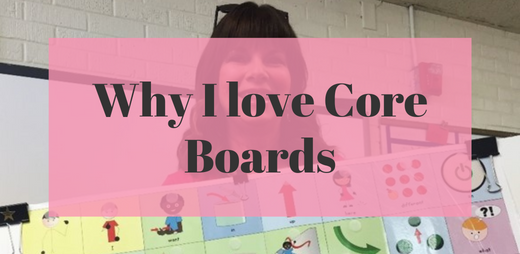
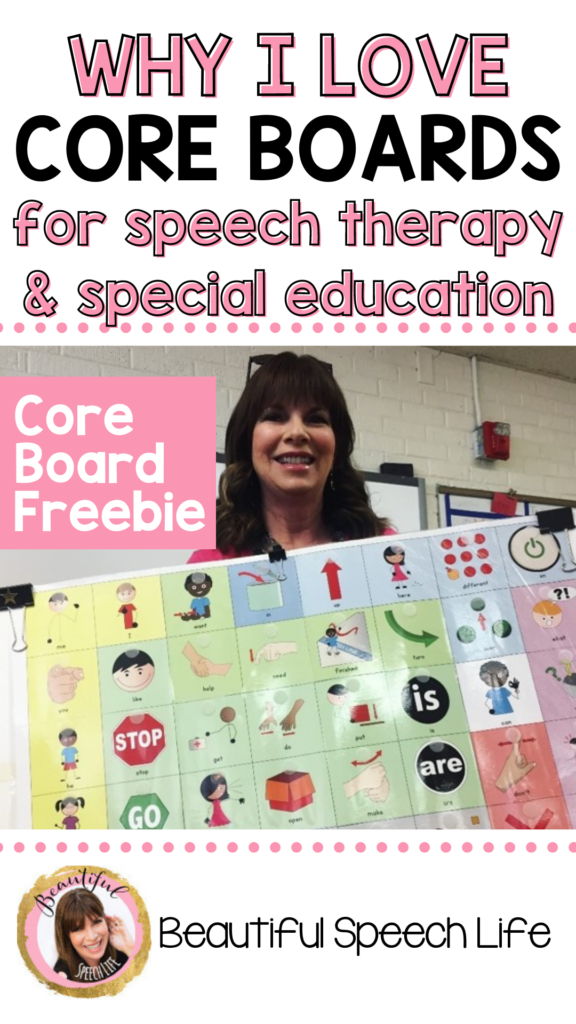
🧡🧡🧡 I love core boards because:
They help make an abstract word visible by giving it a symbol and a location
Visuals can focus a student’s attention and help them filter out distractions
Many kids with disabilities have strong visual skills
They help give language visible structure and a visual pattern
It gives a visual foundation of frequently used words
They work
A big board is great for everyone in preschool classrooms, special education classrooms and in your speech rooms too.
If you are looking for help with core boards, then download your condensed guide to core boards here. You’ll find links to popular AAC boards, along with tips to get started.
As SLPs we often work with emergent communicators. How we model with them needs to be tailored to their specific needs. Below I share more about what an emergent communicator is and my best tips for using AAC modelling with them.
What is an Emergent Communicator
Emergent communicators can use the following modes of communication:
facial expressions,
body language,
gestures,
vocalizations, and
other non-symbolic modes of communication. For example: smiling, reaching for what they want, taking your hand to what they want. They make wants known indicated by reaching toward something, looking at it, and leg movements.
Introducing AAC to Emergent Communicators
My number one tip for introducing AAC to emergent communicators is to remember beginning communicators talk about what they want to talk about. Make sure what you are modelling is meaningful and hopefully fun to them.
Once you are communicating about something they are interested in, then it’s important to model without expectation. Invite don’t demand that they take part in the activity.
Being prepared as an SLP
As an SLP, it can feel intimidating navigating how to use a device and knowing what to do when using AAC. Particularly if it’s the first time you’ve worked with AAC or a particular device.
If this is you, then quickly get familiar with the device. Most devices are fairly straightforward to use once you’ve used them a few times. I’ve been sharing reviews of devices and apps on Instagram. You can find them in my Instagram feed.
I recommend knowing a few basics and starting with core words like in, put, finished, more, want, like, go. Choose an activity that happens everyday like snack time, circle time, lining up time. That way you’ll get lots of practice every day.
Remembering to keep it fun, simple, consistent and real.
Setting goals is a great way to help you do this. To help you set AAC goals, I’ve created the Ultimate AAC Goal Planning Blueprint which you can download for free here.
Help your students succeed by reducing cognitive load for your students with special needs while they’re learning a new concept.
In this video I am talking about why we need to think about reducing the cognitive load as well as how to do this so we can help our students succeed and feel more confident.





 Hey there I’m Anne Page. I help heart centered SLPs and educators put the fun in functional communication.