by Anne Page | Sep 12, 2025 | AAC, Therapy Materials and Ideas, TPT Products
Why This Resource Matters
Teaching AAC core vocabulary can sometimes feel overwhelming—how do you keep lessons engaging, target essential words, and still manage your time effectively? The AAC Core Vocabulary Activities Bundle Boom Cards for Speech Therapy, Autism was designed to make this process easier. With interactive, digital activities created specifically for speech therapy and special education, this bundle helps students practice and generalize core vocabulary in meaningful, fun ways.
No more shutting down when the student sees another worksheet or the same activity you did last week. Students love the hands-on, interactive nature of these activities.
Challenges Teachers Face
If you’ve worked with students who use or are learning AAC, you’ve probably experienced some of these frustrations:
- Student engagement is hard to maintain. Traditional paper activities or repeated drills don’t always capture attention.
- Preparation takes too much time. Printing, laminating, and organizing materials can eat into planning periods.
- Functional practice feels limited. Without the right resources, it’s tough to target core words in natural and motivating ways.
- Repetition gets stale. Students need multiple exposures, but doing the same activity over and over can cause frustration instead of progress.
This is where the bundle steps in to provide a solution.

How This Bundle Helps
Here’s what makes the AAC Core Vocabulary Activities Bundle stand out:
- Covers essential words. Multiple Boom Card sets focus on key AAC core words, giving you a variety of teaching opportunities.
- Built-in engagement. Drag, click, and move features keep students actively involved while reinforcing vocabulary.
- Ready in seconds. Just open the Boom Cards on a tablet, computer, or Smart Board—no cutting or laminating required.
- Flexible for every setting. Perfect for individual therapy, small groups, push-in services, or home practice.
- Variety with repetition. Students get repeated exposure to essential words without losing interest.
- Inclusive and adaptable. Ideal for students with autism, non-speaking learners, or anyone benefiting from AAC.
What Teachers Are Saying
Educators who have used this bundle are seeing results:
“My students LOVE these activities! They’re simple, engaging, and perfect for reinforcing core words.”
“I finally found something that keeps my group focused while giving me multiple chances to model vocabulary.”
“The no-prep factor is a lifesaver. I just log in and we’re ready to learn.”

Where to Find It
If you’re ready to make AAC core vocabulary practice easier, more engaging, and more effective, you can get the AAC Core Vocabulary Activities Bundle Boom Cards for Speech Therapy, Autism here:
👉 Click here to grab the bundle on TPT

by Anne Page | Sep 1, 2025 | AAC, Freebies, Inspiration, Therapy Materials and Ideas
Fall is in the air—the crisp mornings, pumpkin spice lattes, and cozy sweaters signal a brand-new season. For many students, this time of year is full of excitement: from pumpkins and costumes to colorful leaves and Thanksgiving traditions. Why not bring that same seasonal energy into your fall themed speech therapy sessions?
Holiday and seasonal themes are a powerful way to make therapy meaningful and fun. Pair those themes with interactive tools like Boom Cards, and you’ve got an engaging recipe for learning AAC core vocabulary all season long.
Why Fall Themed Speech Therapy Works So Well 🎃
Fall is naturally engaging for kids because it connects to what they’re already experiencing outside of therapy. Themed activities can:
- Build excitement: Pumpkins, costumes, apples, turkeys—these are fun, familiar, and easy conversation starters.
- Encourage connection: Students can share their personal experiences (“I went to the pumpkin patch!” or “I ate pie!”).
- Make repetition feel new: Using the same therapy structure with different seasonal visuals keeps things interesting.
When you use fall themed speech therapy activities, your sessions feel timely, exciting, and fresh.

Bringing Boom Cards Into Fall Themed Speech Therapy 💻
Boom Cards are a fantastic way to blend technology, interactivity, and seasonal fun. The click-and-drag features, bright visuals, and built-in reinforcement keep kids motivated while you target language goals.
Here are a few ways to use fall-themed Boom Cards:
- Target Core Vocabulary: Practice words like put, in, on, go, look while putting candy in a pumpkin or placing leaves on the ground. 🍬
- Practice WH Questions: Seasonal decks make questions more fun—“Where is the turkey?” “What do you wear for Halloween?” 🎁
- Support AAC Users: Model and encourage students to press their core words in real contexts, reinforced by the activity. 📱
- Encourage Generalization: After the digital play, follow up with real-life props (decorate a paper pumpkin, sort leaves, or set up a mini Thanksgiving table). 🌲
Fall themed speech therapy activities like these keep students engaged while giving you plenty of opportunities for modeling and repetition.
Tips for Making Fall Speech Therapy Extra Memorable ✨
- Pair your Boom Cards with real props (mini pumpkins, leaves, fall hats). 🎩
- Send Boom Card codes home so families can keep the fun going. 🏠
- Let students vote for their favorite activity at the end of the session for extra buy-in. ✅

If you’re looking for no-prep, festive materials to make your fall themed speech therapy sessions shine, here are some favorites:
Wrapping It Up ❤️
Fall is the perfect time to refresh your therapy sessions with new themes and interactive resources. By weaving in pumpkins, turkeys, leaves, and all the cozy fall fun, you’re not only hitting core vocabulary goals—you’re making therapy an experience your students will remember and enjoy.
✨ Here’s to a season of learning, laughter, and plenty of autumn cheer. ✨
P.S. Don’t forget to download the FREE Fall WH Questions Sampler—it’s the easiest way to bring a little fall magic into your next session! 🍎
by Anne Page | Mar 8, 2025 | AAC
AAC, or augmentative and alternative communication, refers to various methods and tools used to aid individuals who have difficulty communicating through speech. This guide, “Unlocking Communication: A Guide to AAC Funding and Resources,” provides valuable information to help navigate the often complex process of obtaining funding for AAC devices and services.
Whether you’re a parent, caregiver, or professional working with individuals who need AAC support, this article will equip you with the preliminary knowledge and resources to unlock the potential of communication for those in need.
General Information
https://aacfunding.com/funding-101/how-to-obtain-funding
https://aacfunding.com/funding-101/insurance-tips
https://aacfunding.com/resources/alt-funding-sources
This includes links to different states
Medicaid, Medicare
Medicaid may cover (see your state’s guidelines) AAC devices/services for eligible children as long as they are medically necessary
Private Insurance
Get help from Ablenet Quicktalker, Forbes AAC
Schools (Assistive Technology Department, SLP, SLP lead for the district):
If the IEP team determines that a student needs AAC to access their curriculum the Local Education Agency (School District) must provide AAC.
Vocational Rehabilitation
Check for your state
Tri Care (uniformed service members)
Veterans Affairs
Lilly’s Voice
Assists children ages 2-18 that have been rejected by other programs and whose families cannot afford an AAC device without help.
The Arc
(The Arc promotes and protects the human rights of people with intellectual and developmental disabilities and actively supports their full inclusion and participation in the community throughout their lifetimes)
For Pennsylvania
https://www.varietypittsburgh.org/my-voice/eligibility/
For Texas
STAP Specialized Telecommunications Assistance Program-Texas Health and Human Services
Advocates that work with insurance :
https://www.lincare.com/en/services/speech-generating-devices/funding-your-device
https://www.talktometechnologies.com/pages/funding
What to do while you’re waiting for a device:
Use low tech AAC Core Boards
Low tech AAC core boards are used for communication. We point to these words while we’re talking. We say things like “want more?” “you like it” . We’re giving each child a visual that he can see and eventually point to.
By focusing on these words we are teaching a functional vocabulary. Your child can use these words all day, everyday, everywhere: from classroom to playground to cafeteria to home. Plus, the words will always be in the same place (so he doesn’t have to search for them).
Get your free guide here.
Use a Free AAC App
Weave Chat AAC is a free, robust, category-based AAC app that can be used on phones and tablets. it can be downloaded and used for free on IOS, Android, & Kindle products. I have personally tried this and find it to be a robust, versatile app. Learn more here.
The journey toward securing funding for AAC devices and services can be challenging, but it is essential to empowering more complete communication for non-speaking and partially speaking students.
With perseverance, knowledge, and the resources outlined in this guide, you can navigate the process and provide your loved one or client with the tools they need to communicate effectively. Remember, every voice deserves to be heard, and AAC can make that possible.
If you know of additional resources please comment here or email hello@beautifulspeechlife.com
by Anne Page | Jan 18, 2025 | AAC
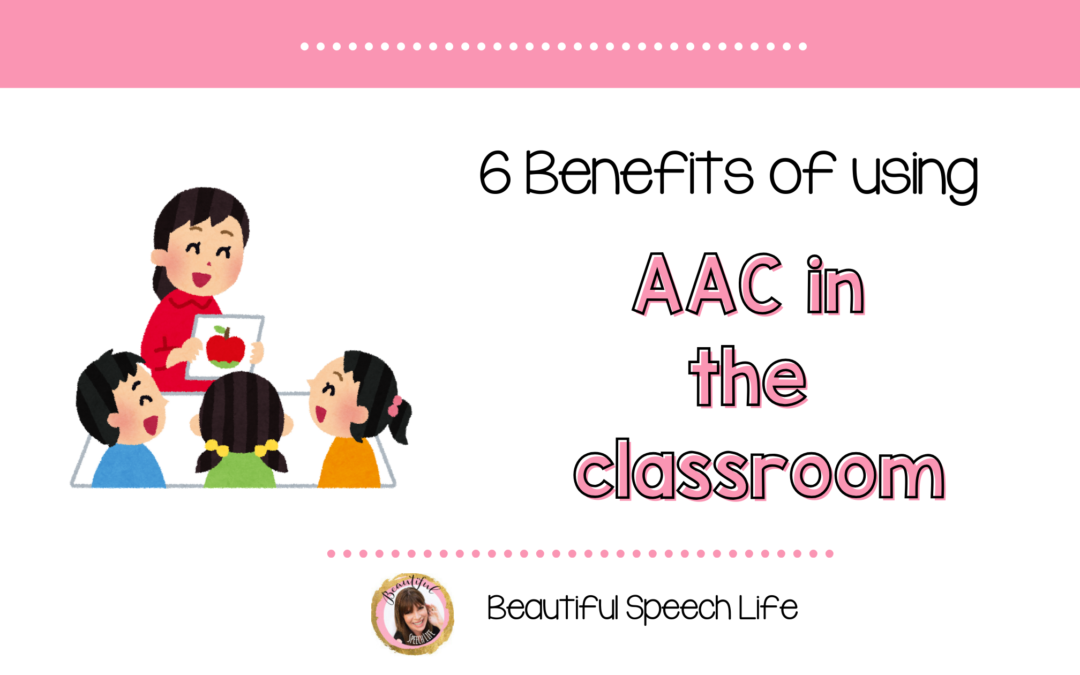
Augmentative and alternative communication (AAC) is a valuable communication method that can transform the school experience for our students with communication challenges. By providing an additional means of expression and understanding, AAC empowers our students to participate more fully in classroom activities, fostering their learning and overall development.
In this article, let’s explore the significance of AAC in the classroom and discuss its numerous benefits for students with communication difficulties. We’ll dive into how AAC can enhance communication, support language development, promote independence, encourage participation, facilitate social interactions, and assist in tracking progress and assessment.
- Enhancing Communication: AAC bridges the communication gap by providing tools and strategies for effective expression, assisting in meaningful interactions and understanding. Implementing AAC effectively can unlock new opportunities for students with communication challenges, empowering them to engage in their learning actively. No more sitting quietly at their desk playing a game, so they’ll be quiet. Now they can be an active participant.
- Supporting Language Development: AAC supports language development by offering visual and auditory supports, promoting vocabulary expansion, sentence structure comprehension, literacy skills, and overall language acquisition. Practicing functional communication through AAC in the context of academic tasks can expand a student’s communicative repertoire and increase overall language proficiency.
- Promoting Independence: AAC fosters self-advocacy and autonomy by enabling students to express needs, make choices, and actively participate, increasing confidence and self-esteem. They are also able to take an active role in their learning.
- Encouraging Participation: Students using AAC can actively participate in classroom activities and lessons aligned with grade-level curriculum standards, promoting inclusive education and equitable learning opportunities. Allowing students to contribute, engage, and share facilitates a sense of belonging and inclusion.
- Facilitating Social Interactions: AAC supports social relationships and friendships by enabling effective communication, breaking down barriers, and creating opportunities for building meaningful relationships. Students can participate in group discussions, share interests and express their opinions.
- Tracking Progress and Assessment: AAC provides a framework for monitoring progress and conducting assessments, enabling data-driven decision-making and individualized education planning. It’s so helpful for teachers to chart progress.
The Transformative Power of AAC in Inclusive Education
Augmentative and Alternative Communication (AAC) is not merely a tool but a gateway to communication, connection, and learning for students with complex communication needs. AAC encompasses numerous strategies and technologies, from low-tech picture boards and symbol systems to high-tech speech-generating devices and eye-gaze technology. By augmenting or providing alternative means of expression, AAC empowers students to communicate their thoughts, feelings, and needs effectively, assisting language development and cognitive growth.
Beyond Communication: AAC’s Multifaceted Benefits
The benefits of AAC extend far beyond communication. By enabling students to participate actively in classroom activities, AAC promotes independence and self-advocacy. It facilitates social interactions, allowing students to build relationships with peers and engage in meaningful conversations. Furthermore, AAC supports academic learning by providing access to the curriculum and enabling students to demonstrate their knowledge and skills. By tracking student responses and progress over time, AAC can also assist in assessment and individualized education planning.
Fostering Inclusive Education: AAC’s Pivotal Role
AAC plays a pivotal role in creating inclusive learning environments where all students can learn and thrive regardless of their communication abilities. By removing communication barriers, AAC ensures equitable access to education and fosters a sense of belonging and acceptance. It empowers students to actively participate in their educational journey, contributing their unique perspectives and enriching the learning experience for all.
Empowering Students, Enriching Lives
AAC is not just about enabling communication; it’s about empowering students to reach their full potential. By providing a voice to those who have not been heard, AAC unlocks a world of possibilities. It aids personal growth, academic achievement, and social connection. AAC is not merely a tool; it is a catalyst for change, transforming lives and shaping futures.
Want to know more using AAC in your classroom?
Ready to dive in to learning more about AAC? These blog posts will get you started:
Using AAC Core Boards
Which AAC device should you choose
When, Why & How to Use Guided Access for AAC
Writing Smart AAC Goals: 5 tips
Explaining Speech Language Evaluations in Parent Friendly Terms
You will see from the blog post on using core boards that not all AAC has to be high tech. It’s one of the reasons I love core boards so much. Even if you have students who don’t yet have a device you can get started by printing out a core board and begin modelling with your students. They are such a simple way to start the conversation.
To start or build on using core boards, I’ve put together a document sharing where you can download free core boards to begin using them with your students. Click here to download your copy.
by Anne Page | Aug 26, 2023 | AAC, Quick Therapy Tips for the SLP and SLPA
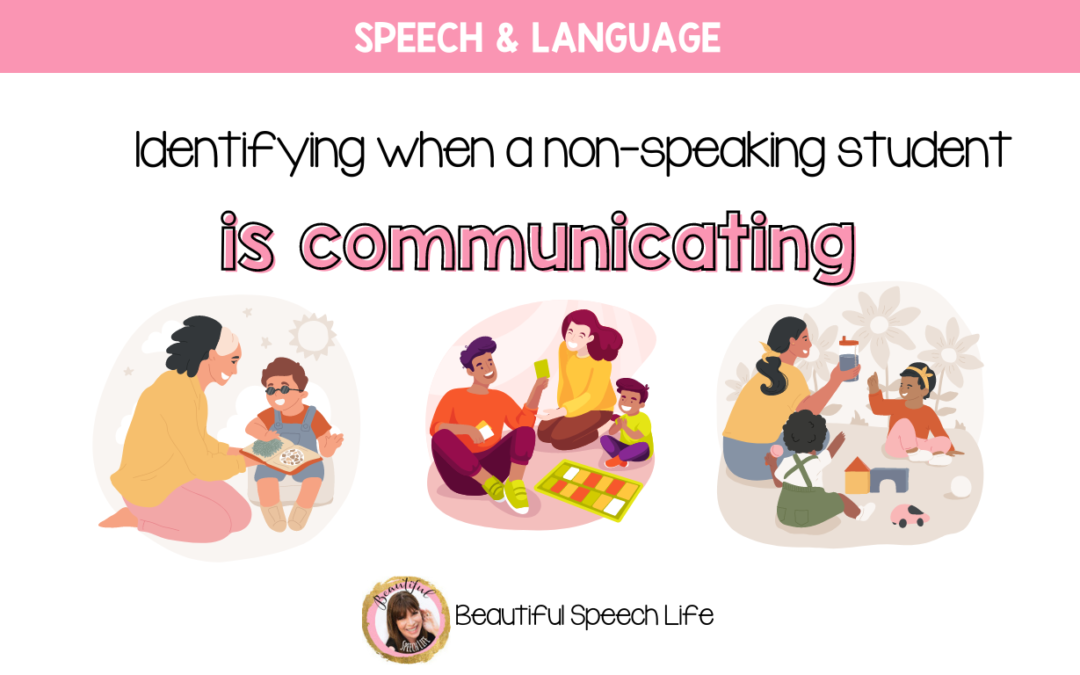
Our goal as an SLP should always be to prioritize communication, rather than verbal speech. For each child to “say” what he wants to say, when he wants to say it. But it isn’t always easy to tell when a student is communicating with us.
When I first started working with students with significant cognitive disabilities, it was kind of scary because I didn’t know what to do when a student didn’t have a way to respond. Or at least I thought they didn’t have a way to respond.
As I’ve spent more time working with these students, I’ve learnt that they do have a way to respond. I just need to work out what that way is and use it to develop a system of communication that works for the student AND that more people in their environment can understand.
I learned that what you do is keep investigating and going back and trying things. Working to identify both speaking and non-speaking methods the student may be using to communicate.
Understanding the student’s baseline
One of the best ways I found to do this is to talk to the student’s family. Ask them things like, “How do you know when your child is uncomfortable?” or “What does he do when he is hungry?” Then you learn that there might be different cries, or that the child communicates he wants something by looking at it.
What we’re figuring out is the student’s baseline. Once we have that then the next step is working out how to build on it. We try to teach them a system of communication that we all understand – something that can take them throughout their lives.
With one student, we started noticing that he makes clicking sounds with his tongue and that means “I’m talking.” If you click back, he’ll click back. Now we’ve got a little conversation going on and we’re trying to build on that.
I also encourage you to share with your student’s parents and caregivers what they can do. Too often we are constantly telling parents and carers what their students can’t do. I share an example of how to do this in this Instagram post. In this example is a student I have who is starting to communicate by looking at people at they come into the room. I wanted to share with this student’s mother that there are things her daughter can do and that her daughter is starting to communicate.
And remember if you think a child may benefit from AAC, try it. There isn’t a need to wait. It won’t stop a child from developing speech. Actually, early implementation of AAC can help in the development of language and natural speech. (Romski et al., 2010; Luke, 2014; Wright, Kaiser, Reikowsky, & Roberts, 2013) It doesn’t need to be high tech. It can be as simple as a printed core board. You can get my Big Core Vocabulary Board here.
Looking to find out more about AAC? Learn more about my experiences with AAC in my interview with WIDA.
Pin to read later:
by Anne Page | Jan 31, 2023 | AAC
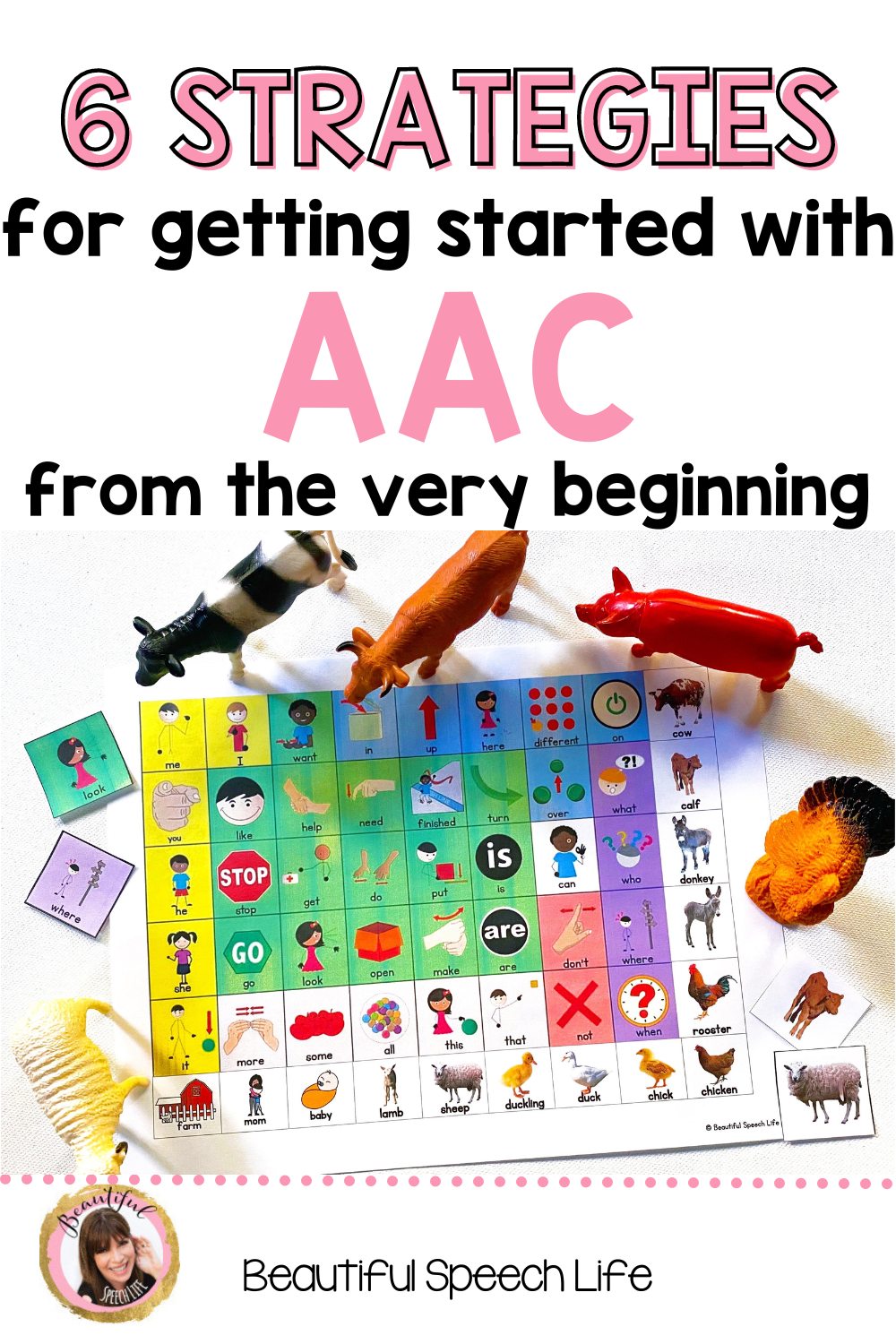
Augmentative and alternative communication (AAC) refers to a range of methods and tools that can be used to help people who have difficulty speaking or communicating effectively. (For more, read What is AAC?). But getting started with AAC can feel daunting. If you’re looking to help a child to get started with AAC, here are a few strategies to consider:
#1 Identify the child’s communication strengths and needs: It’s important to assess the child’s communication abilities and needs before choosing an AAC system. You should, if at all possible, work with a speech-language pathologist (SLP). SLPs are trained language experts and will be able to provide a full assessment. If you are somewhere where this isn’t possible, The Communication Matrix is an online assessment tool created to help families and professionals easily understand the communication status, progress, and unique needs of anyone functioning at the early stages of communication.
#2 Explore different AAC options: There are many different types of AAC systems available, including low-tech options like communication boards and high-tech options like speech-generating devices. It’s important to explore different options and choose one (or more) that are appropriate for the individual’s needs and abilities. If you are getting funding through Medicaid or insurance, it is common for these providers to require AAC trials on a minimum of three devices. Here are a few options to explore:
- Quicktalker Freestyle has a very informative website and they will help check if your insurance provider covers AAC.
- You can try low tech core communication boards. Pop over here to download my guide to core boards which includes links to popular AAC core boards. Additionally, here is a core board and farm themed activities.
- You can try the TouchChat app for free for 30 days: TouchChat Discover.
- Many AAC apps are on sale for ½ price in October for AAC Awareness month
#3 Involve the child in the decision-making process: It is important to involve the child in the decision-making process when selecting an AAC system. This can be as simple as using an AAC app during an activity, then trying a different app and then offering a choice between the two. This can help to ensure that the system chosen is one that they are motivated to use.
#4 Start small and build up: It can be overwhelming for both the individual and the communication partner to try to learn an AAC system all at once. It is often helpful to start with a few core words or phrases and gradually build the child’s communication skills over time. Choosing core words to use during activities that occur everyday is a great way to get started. A few examples:
- Brushing teeth: PUT on the toothpaste
- Getting dressed: PUT on your socks
- Going to school: let’s GO, time to GO to school
#5 Model, model, model: What is modeling? It’s you as the communication partner, using AAC to help the child learn AAC. You can learn all about it here. It takes time and practice to become proficient at using an AAC system. Think about how many times a baby hears the word “mama” before they say it. We’re building an understanding of language and a new way to communicate.
#6 Seek support, don’t do it alone: There are many resources available to help individuals and their families learn how to use AAC effectively. These may include speech-language pathologists, support groups, and online resources. Don’t be afraid to reach out for support if you need it.
If you would like ongoing support then come and join us in the AAC Academy. This membership-stye group AAC “coaching” program will build your SLP skills, increase your confidence, and allow you to help ALL of your students strengthen their communication skills.
Pin to read later:

 Hey there I’m Anne Page. I help heart centered SLPs and educators put the fun in functional communication.