by Anne Page | Dec 11, 2017 | AAC, Freebies
I learned so much at the ASHA convention in Los Angeles that I just had to share it with you. After attending outstanding presentations on AAC, I have to let you in on some of my biggest aha moments and takeaways. These five free AAC Resources will make your SLP life easier.
1. AAC for students with visual impairments
This year I’m working with several students who not only have complex communication needs but they also have a visual impairment. These are the kids that I think about a lot. Trying to strategize and come up with some type of a communication system for them is really challenging.
Laura Stone gave an amazing presentation that included resources for purchasing tactile communication systems using Core Vocabulary and suggestions for how to create your own.
STACS: Standardized Tactile Augmentative Communication Symbols Kit is available online
Texas School for the Blind & Visually Impaired has standardized a Tactile System (FREE guide) http://www.tsbvi.edu/images/attachments/Tactile-Symbol-List1.pdf
And you can make your own symbols too using corrugated plastic or cardboard. I’ll be diving deeper into this subject in an upcoming interview with Laura.
2. Low-tech AAC Gems from Gail Van Tatenhove
” Low-tech doesn’t scare the crap out of people.”
” Low-tech is a rich environment in which you can do language.”
” You can have more than one motor plan.”
” Low-tech can temporarily reduce the cognitive load.”
” Look at access, intentionality, and motivation.”
Learn more wisdom from Gail Van Tatenhove, the Queen of Core at https://gvantatenhove.wordpress.com/
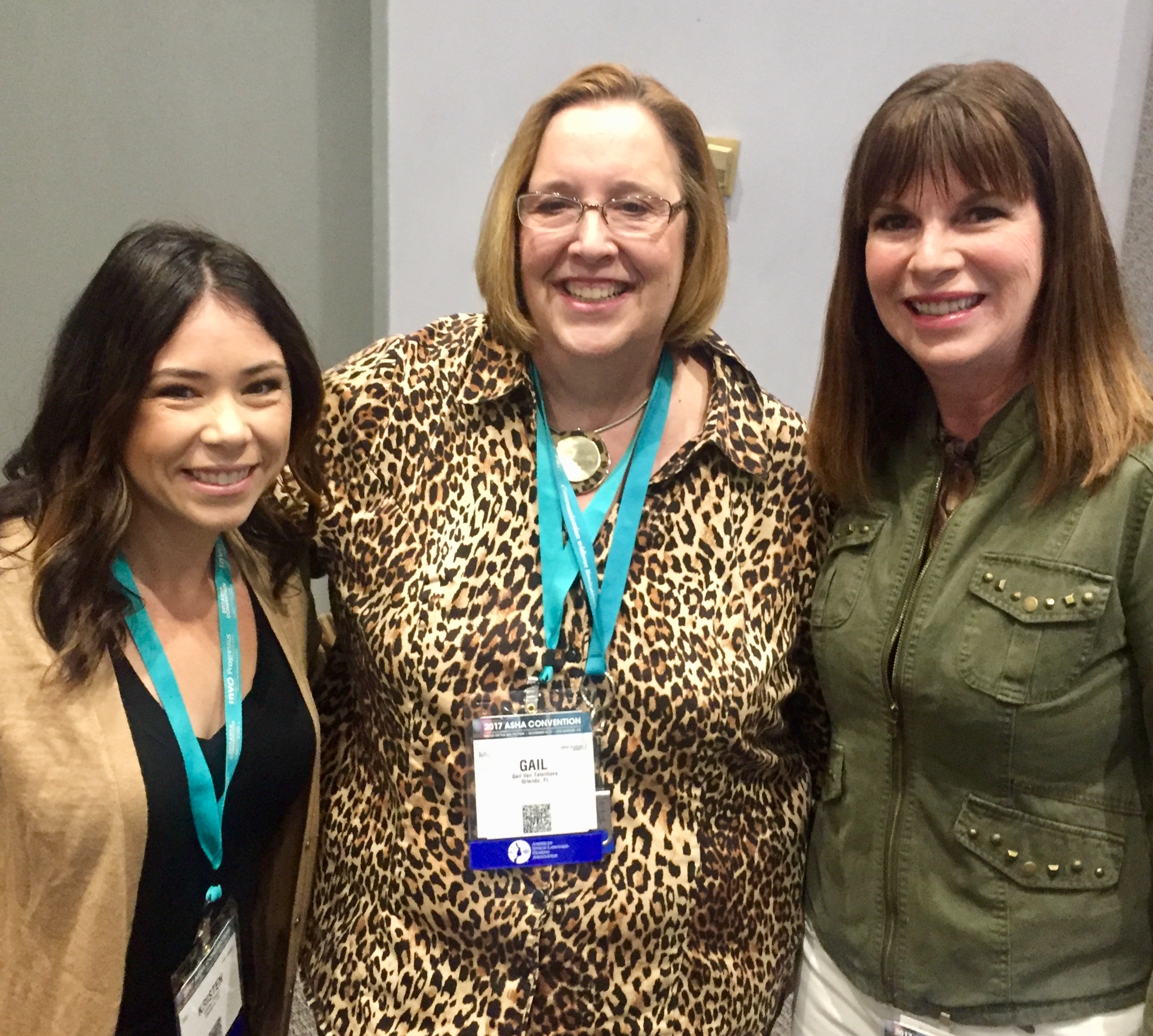
Kristen from The Daily Dose of Speech and I with Gail Van Tatehove
3, 4 & 5. Classroom-wide Core Vocabulary from Project Core
Project Core is a Stepping Up Technology Implementation Grant, directed by the Center for Disability and Literacy Studies at UNC Chapel Hill. Here are a few of the highlights.
- Teach teachers and classroom staff how to teach AAC (this is huge and something I’m always working on)
- “Encourage communication without requiring it.” ~Karen Erickson
- ” It’s not a model, if the child doesn’t see you do it.” ~Karen Erickson
- Make sure there’s a worthwhile topic to communicate about.
- Project Core uses Communication Matrix (which I’ve been using for the past 3 or 4 years) This is a FREE assessment tool that I find invaluable. I’ve included a link on my Resources
- Project Core has free professional development modules http://www.project-core.com/professional-development-modules/
- And FREE posters http://www.project-core.com/teaching-core-vocabulary-posters/
I hope you can use these AAC resources. I know it can be a confusing area with a lot of different resources, devices and vocabulary sets. We just have to keep ourselves informed, reach out to other SLPs, look at evidence and use our best clinical judgement.
I think one thing that all the AAC experts agree on is the importance of Aided Language Stimulation or Modeling.
So, let’s hold that point,

by Anne Page | Oct 12, 2017 | AAC
Do you get a little scared when you are writing AAC goals in the IEP?
As in, you’re just not quite sure how to word the goal, let alone make it smart? Don’t worry, you’re not alone.
It’s easy to get a little overwhelmed and stuck here. I’ve been there. I remember the first time a teacher said ” Oh by the way, Johnny has this talker device thingy in his backpack, what do we do with it?” I knew we had to push buttons to make it talk but honestly that was about it.
When I thought of writing goals and how to include the device, I was really lost.
So now, a few years later, I’ve figured a few things out and done a lot of investigating when it comes to AAC in the IEP. It’s really not a black and white area but here’s how I do it.
Tip #1: Don’t be scared! It’s mostly just language. You’re an expert in language, (remember you’ve got a master’s degree). You’ve got this.
Don’t freak out about the AAC part. Just focus on what you want your student to communicate. Then look at the how. Look across all areas of language not just labeling. If you get stuck, a helpful tool is Communication Matrix (I’ll include a link at the end of this post). You can use it not only for assessment but also for looking at the areas of language use for emerging and beginning communicators. These are: refuse, obtain, social and information with detailed information on the hierarchy of each.
Here’s an example situation:
Currently when Johnny wants an item he points to it and/or physically takes an adult and to the item. We want his next step to be using core vocabulary words (verbally and/or through AAC use) to obtain a wanted item.
Sample goal from Kate Ahern that I really like:
“Given his communication system of 9-12 core words and ongoing aided language stimulation across the school day Johnny will communicate for three different purposes (such as greeting, commenting, requesting, labeling, asking and answering questions) during a 20 minute group activity with no more than two indirect verbal cues (hints).”
Also you can refer to 1988 Janice Light et al who wrote of four competencies for AAC users: Linguistic, Operational, Social, and Strategic. Kate Ahern lists good examples of these in the linked article below.
Tip #2 An AAC goal still needs to be SMART. (A S.M.A.R.T. goal is defined as one that is specific, measurable, achievable, results-focused, and timebound). You’ll be including time frame, conditions (modeling, cuing, prompting), measurement, assessment and baseline; just like you do in your other goals.
Tip #3 Check to make sure you know your district and state’s procedures and requirements. They aren’t all the same. Talk with your lead SLP, Assistive Technology Consultant, School Psychologist or Special Education Director to make sure you’re including all the required information. Find out where your district wants you to document the type of AAC a student is receiving. It could be listed in the goal OR it might be in the Supplementary Aids and Services section of the IEP.
Tip #4 Document the type of AAC equipment, software or low tech AAC in general descriptive terms. You don’t want to name the specific devices because then you’ll be out of compliance if you’re not using that specific piece of equipment. Think about all the times devices are left at home, aren’t charged and even are broken. You want to make sure you have access to an alternate (such as a laminated photo copy of the main screen on a speech generating device). Here are some suggested terms:
Try this: Communication system including coreboard, choice board, and fringe vocabulary
Instead of: Boardmaker, Lessonpix, etc.
Try this: portable speech generating device
Instead of: Ipad
Try this: dynamic speech generating touch screen device
Instead of: Accent 1400
Tip #5 In the IEP present level section explain why your student needs AAC in school and how your student uses AAC. Here’s an example:
“Johnny uses an augmentative alternative communication (AAC) system to request and to comment. Johnny’s AAC includes a 40 symbol core communication board, 6-8 symbol choice boards and a 10-12 symbol comment board. He is using this system in a variety of settings. This AAC system impacts his progress in the general education curriculum because it allows him to participate in class discussions and activities. This allows for assessment of what he knows. “
Then, of course, you’ll include all the rest of your information on goals and progress.
So there you have it, I hope you found this useful. To sum it up your 5 tips to Writing Smart AAC Goals in the IEP are:
- Don’t be scared-it’s just language.
- Remember an AAC goal still needs to be specific, measurable, achievable, results-focused and time-bound.
- Check for district & state procedures/requirements.
- Document the type of AAC in general descriptive terms.
- Back up your goals in the present level by stating why your student needs AAC and how it impacts his progress in general education.
I have to say this is just a quick summary to get you thinking. As always, use your clinical judgement, do your research and reach out to other SLPs.
Here are links to helpful articles I’ve found:
Kate Ahern’s Meaningful and evidence based goals: here.
Gail Van Tatenhove’s AAC in the IEP: here.
Lauren Ender’s Writing Goals for AAC Users: here.
The Communication Matrix: here.
My Three Tips to AAC Like a Boss for Beginners: here
My BIG Core Vocabulary Board: here.
If this is information overload, just bookmark these, so you’ll have them when you need them.
All right let’s all go AAC LIke a Boss,
by Anne Page | Apr 6, 2017 | AAC, Autism, Therapy Ideas
Do you struggle with planning functional communication therapy?
Do you leave those sessions feeling frustrated and like it nothing is working?
I sure used to. And then I discovered the power of Core Vocabulary.
You can add structure, consistency and fun to your sessions by using Core Vocabulary. You’ll be amazed at how you can do more with less!
It’s not just for labeling. These words are used to comment, request and command.
Of course, you want students to learn many other words, these are fringe vocabulary. But by focusing on core words you are teaching them a vocabulary that is used most often throughout the day and that they can use throughout their daily lives from classroom to playground to cafeteria to home.
So what exactly is core vocabulary?
Core vocabulary is a small set of simple words, in any language, that are used frequently and across contexts (Cross, Baker, Klotz & Badman, 1997). These words make up 75-80% of the words we use every day.
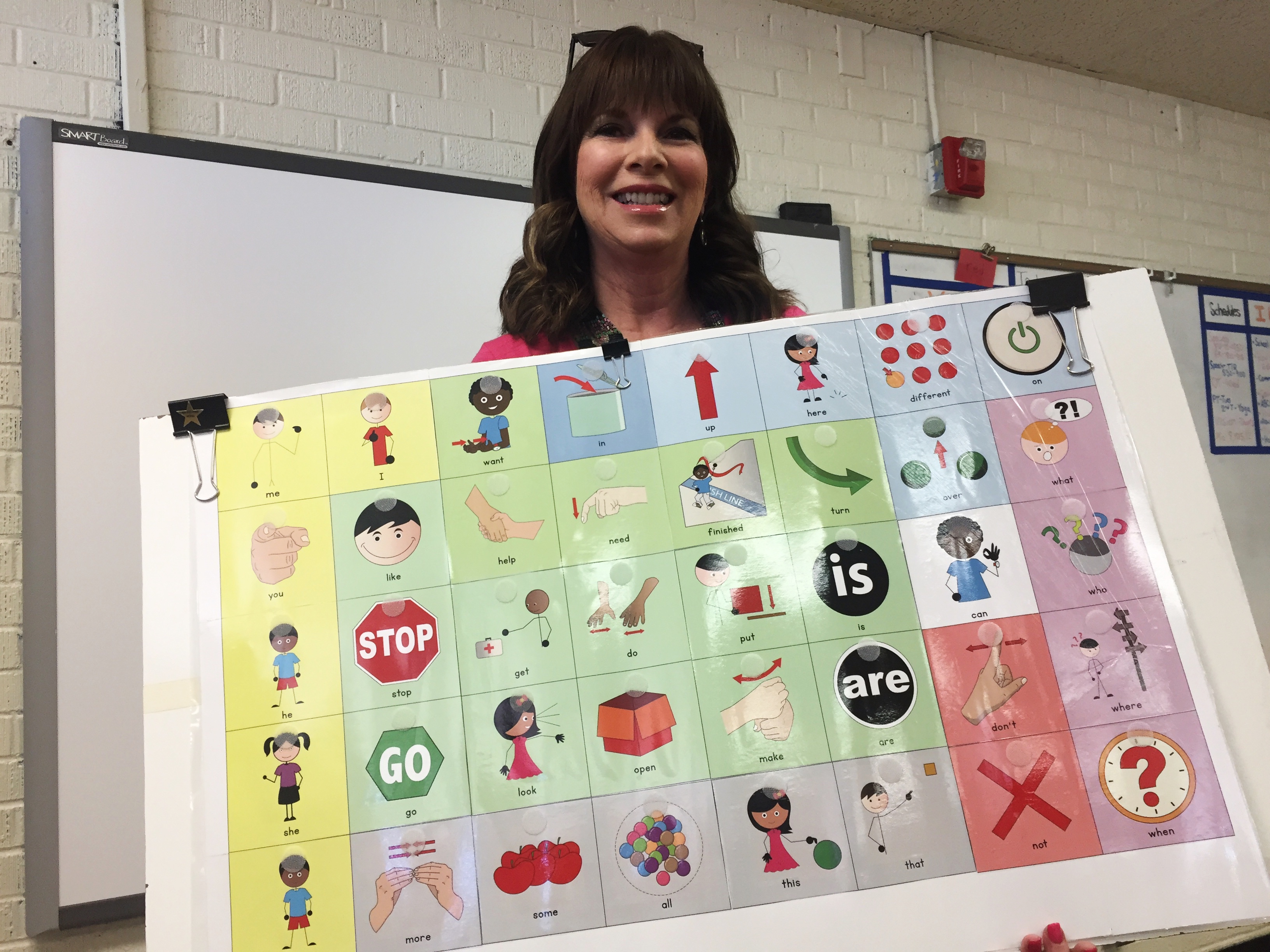
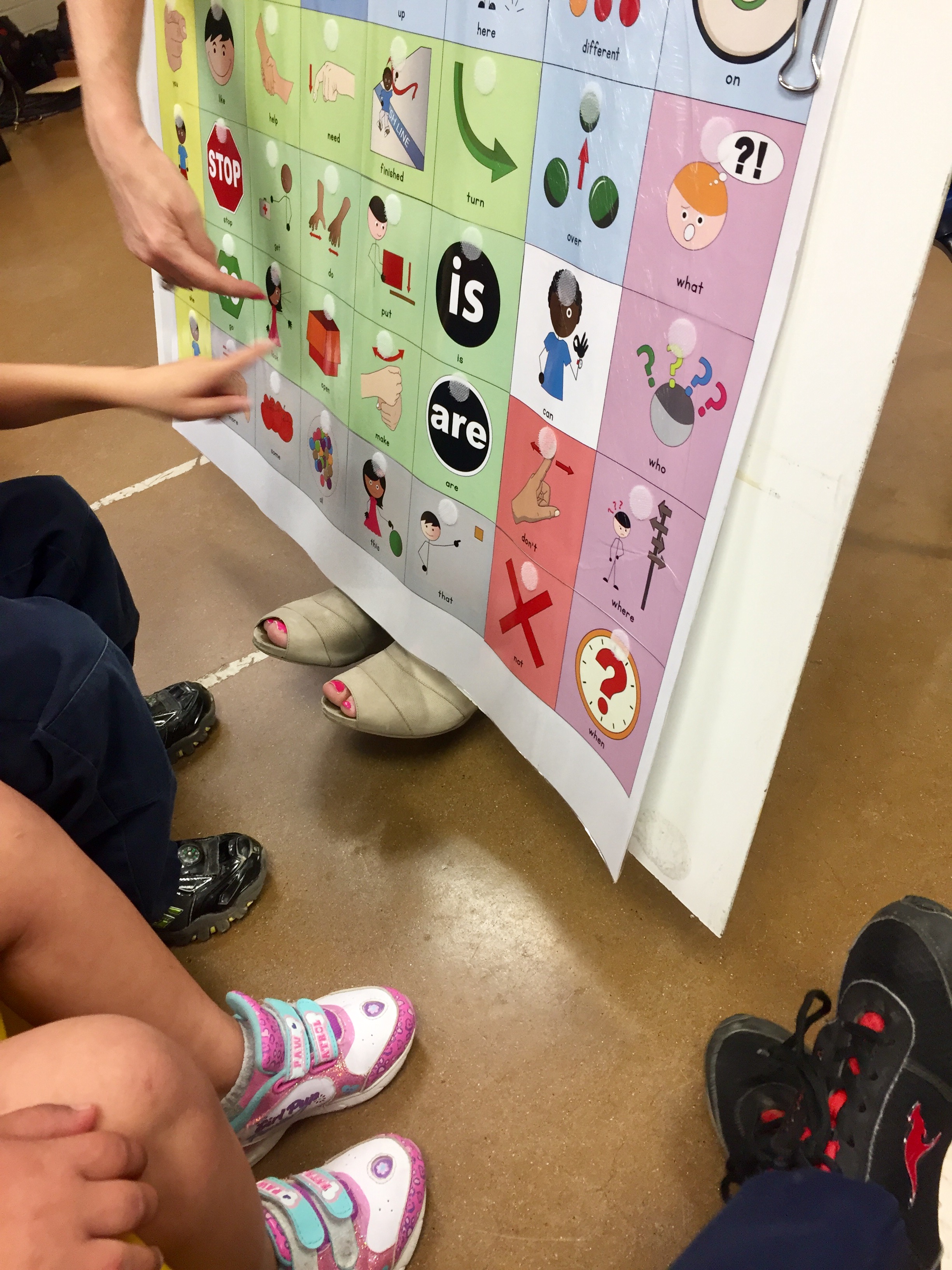
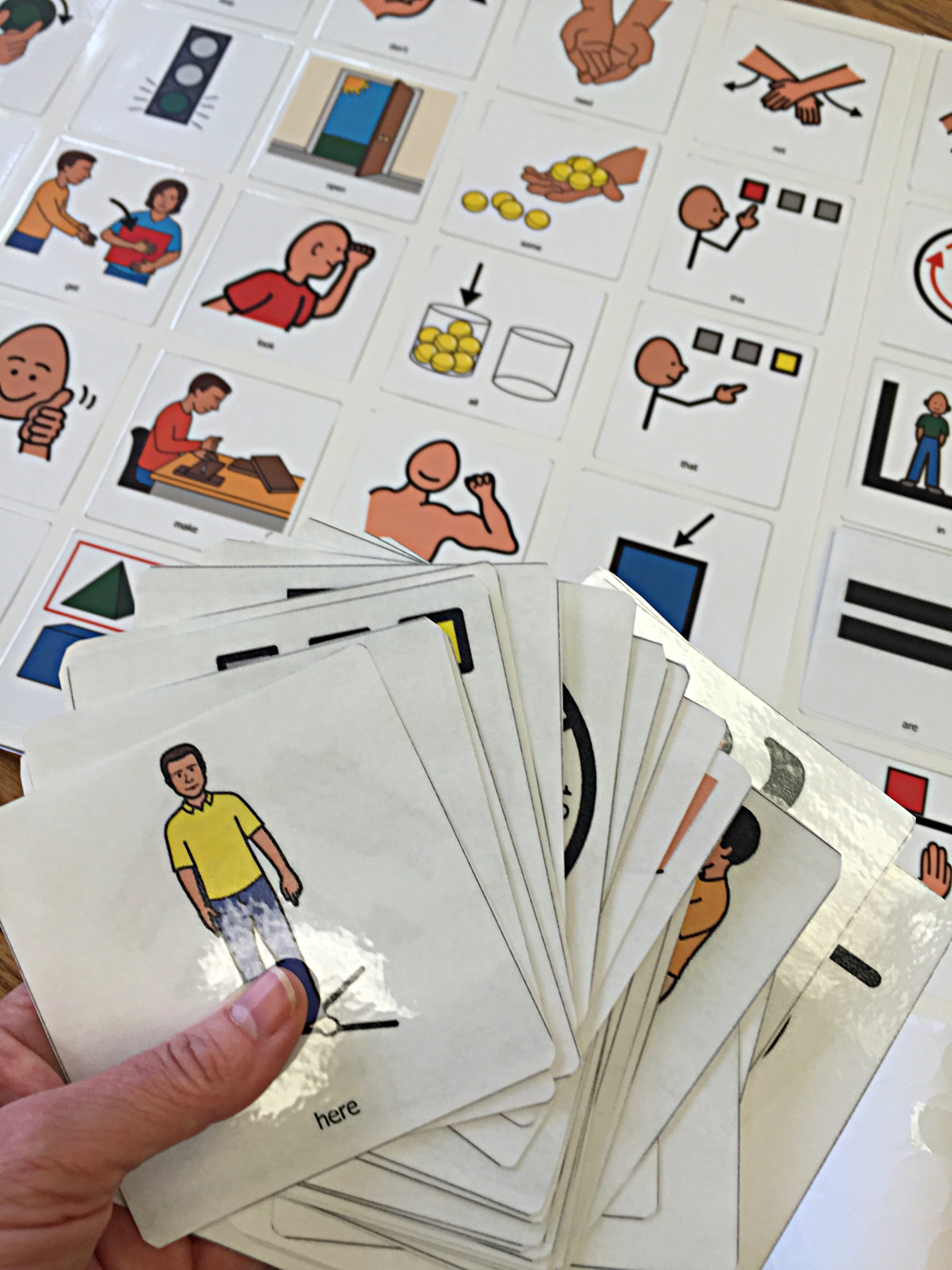
I love to use big core vocabulary boards with my students. You can choose your core words from many sources and create your own board using symbols.
I just created this core vocabulary board. I spent months tweaking the size, the positioning of the symbols and using it with my students. Here’s what I love about it:
- Big squares are easy for little hands to grasp and large enough to see clearly.
- Made for classroom and/or speech room use
- Uses DLM Core Vocabulary words which are evidence based
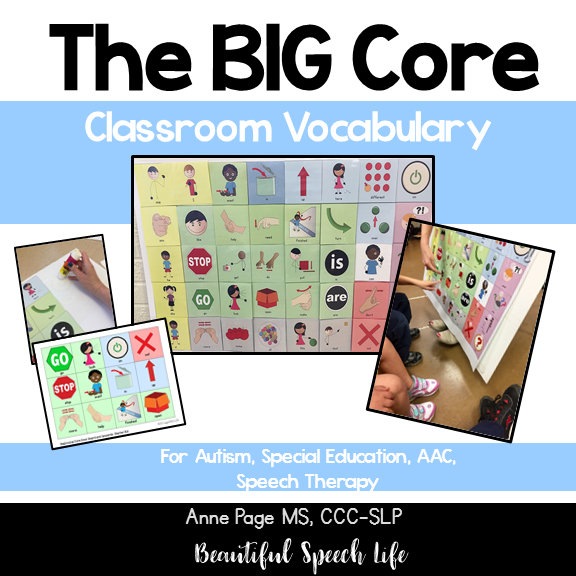
It’s available in my Teachers Pay Teachers store now. Included with the board are two different choices of backgrounds, one vibrant and one more subdued. There is also a smaller poster to put on the classroom door to help with carryover. And smaller squares to use for lanyards to encourage use of the core vocabulary words throughout the day.
If you’re sold on Core Vocabulary but wondering how to get started, I also included enough ideas to get you through a few sessions incorporating wind-up toys and movement.
Click on this link to see the Big Core Vocabulary Board.
Psssssst…April 7th only….This is at an Introductory Price of just $5.00 (I know are you kidding me? That’s a whole lotta resource, that will last a lifetime)
I hope this gives you a good start. I don’t teach core vocabulary for the whole session, but consistently work it in for 10 to 15 minutes of each 30 minute session.
Keep coming back, because I’ll be sharing more ideas on how to use core vocabulary to make communication gains. Also join me on Instagram, where I share lots of ideas in my Instastories.
I’d love to hear from you once you’ve tried this. How did it work for you? What new ideas did it generate?
Hugs and high-fives,
by Anne Page | Jan 21, 2017 | AAC
Did you catch my “Putting the Fun in Functional Communication” presentation last week on SLP Summit? I hope so. I really enjoyed the interaction but to be honest it was really hard to talk and keep up with the chat feature of the platform. Luckily, I was able to review the entire chat to make sure I can answer everything for you.[spacer height=”20px”]
Here’s where you can find the most asked about items:[spacer height=”20px”]
In case you missed the session, you can still see the recorded version until January 31, 2017 at
SLP Summit. Here is a quick review of how to use each item.[spacer height=”20px”]
Magic wand
Use as a reinforcer, to teach greetings and farewells. PS don’t let the students hold it or the magic will disappear.[spacer height=”20px”]
Penpal program
This amazing program is the brainchild of Kim from Activity Taylor and Gabby from middle school speech. This year, my junior high functional skills class in Arizona is paired with a similar group of students in Oregon. With so many opportunities to pair language with a daily living type of activity, this program is a big hit! Learn more by emailing Kim: kim.lewis@activitytailor.com[spacer height=”20px”]
DLM core words
You can find them here. Also here’s an
article with more details on how are use them.[spacer height=”20px”]
Products for middle school and junior high
I developed these because I was really having a lot of trouble teaching prepositions to my students. These books combine teaching one concept with errorless learning and lots of repetition.[spacer height=”20px”]
Sign language
I like using sign to reinforce the core vocabulary words. Also it seems like I usually have a student transfer that uses sign language. My friend Adrienne who is an SLP has a wonderful online sign language course. Use my
affiliate link to learn more.[spacer height=”20px”]
Cough drop AAC
I’m just trying this with a student now and so far I’m really impressed. I’ll be interviewing the owner for an upcoming article very soon. In the meantime, Coughdrop AAC offers a two month free subscription for users. They also let SLPs use this app for free to evaluate students. Contact Scott at
Coughdrop AAC for more details.[spacer height=”20px”]
Core vocabulary
Teachers pay teachers has many core vocabulary products. Susan Berkowitz, Jenna Raeburn and Felice Clark have resources that you can check out. I’m working on a core board that I’ll be listing soon.[spacer height=”20px”]
You’ve got this,[spacer height=”20px”]
Anne
by Anne Page | Jun 13, 2016 | AAC, Autism, Therapy Ideas
Last week I shared 3 tips on how to AAC Like a Boss. They were:
- You don’t have to know everything
- Be Resourceful
- You don’t have to start high-tech
To continue along this line, today I want to talk a little bit about how I used all three of these tips to make a breakthrough for one of my students.
I’ve been doing group therapy with students who are working on functional communication for the past nine years. I don’t know about you, but I get really discouraged when my students don’t make progress. However, I think I was setting the bar too high too soon. Of course I want them to be able to communicate their wants and needs. There are just so many little steps to getting there; it can take a really long time!
This year I started using The Dynamic Learning Map Core Vocabulary; a list of 40 words that have been proven to be most effective socially and academically for students with significant cognitive disabilities. Developed at the Center for Literacy and Disability Studies at The University of North Carolina at Chapel Hill, these 40 words are based on AAC research.
My Core Vocabulary Board
This is both low tech and resourceful. Plus I really didn’t know everything about it, but I did do my research and know that it’s backed by evidence. I made a core vocabulary board for my room and decided to see what happened.
Let me tell you a little story to illustrate my point. I’ve been working with a little guy, let’s say his name is Benjamin (it’s not) for the last four years. Benjamin came to our school as a kindergartener with a diagnosis of Autism. He was nonverbal. His IEP from preschool had a following one step directions goal and an expressive language goal to “communicate his wants and needs using total communication”.
For the first two years, Benjamin had to learn to follow classroom routines and follow directions. His sensory integration needs were high and we were trying to figure out how to meet them. I felt like a total failure as an SLP. He didn’t say words, he didn’t use signs, and he didn’t have joint attention. He stayed in his own little world. But, he did learn to follow simple directions with visual and verbal prompts.
We have a little farm at our school and Benjamin was really interested in the animals. It was motivating and calming to him to be able to watch them. Soon he started labeling them. His parents bought him little plastic animals and taught him the names of over 100 animals. Progress, sort of. He still didn’t greet, comment, request or command. There was no joint engagement or joint attention. No pointing. He was just naming the animals for his own benefit. Not looking to see if we were listening, not wanting to share his discovery. If he couldn’t physically go get what he wanted, he would guide an adult’s hand to the item. Benjamin demonstrated echolalia and a lot of screaming.
Then we he was in second grade we taught him to request by labeling. We used beads, which he loves to roll and toy animals, which he loved to line up. I was able to get some eye contact by holding the item he wanted by my eyes. He had to look at me and say what he wanted. After a while, we (me, the paraprofessionals, the teacher and his parents) got him to add “I want” but he needed a verbal prompt each time.
Benjamin got an iPad with TouchChat that he was able to use but he hasn’t been too interested in it.
This past school year, he changed classrooms and it took a good four months for him to settle into the new routine. His communication progress was at a standstill. Actually, he even regressed.
I was so sad. I had just told his mom that I wasn’t making any progress with him in group therapy sessions. He was falling asleep, or hanging off of his chair or screaming; sometimes all three in one session. The other kids were so distracted. I made arrangements to see him for individual therapy for a while.
The next day, Benjamin’s teacher forget to tell the aides about the new schedule and they brought him to my room with the group. I said, okay let’s just try one more time.
I was introducing the new core vocabulary board I made and planned to teach the command “go’ through the use of the picture symbol. I set up a little miniature bowling game on the table. I noticed I had Benjamin’s attention, so I let him go first. Big Therapy Win! He participated with minimal prompts for the first time ever. He loved the Core Vocabulary Board with the bowling. In this picture, he’s waiting, holding the ball until we (his classmates and I) say “go”. We had joint attention, joint engagement with PEERS, and smiling. I wish I would’ve filmed it.
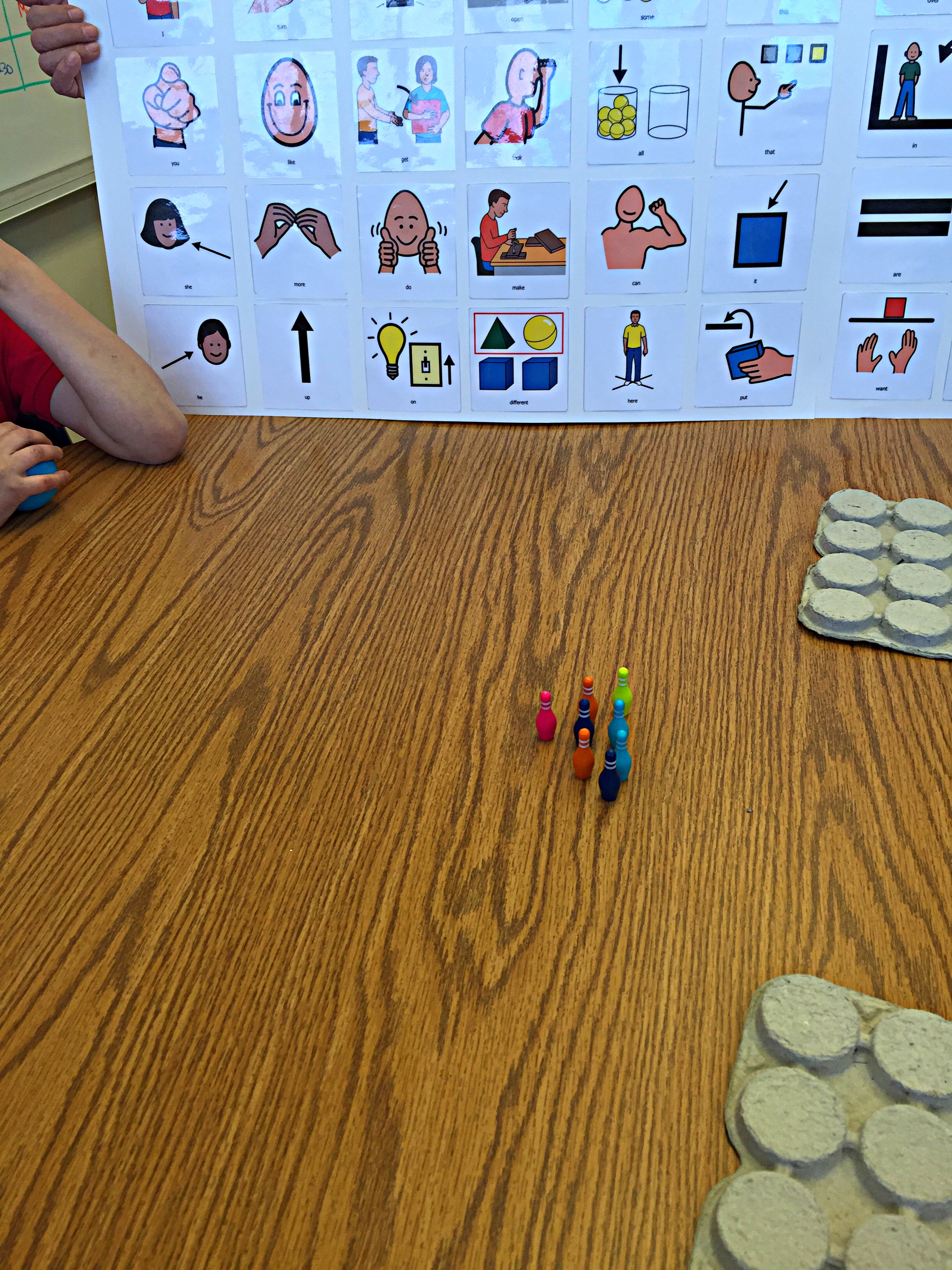
Therapy Win!
That was in January. Ever since then, he’s been participating. I keep the sessions really active with pop-up toys, wind-up toys and balls. So far he’s learned “go”, “stop”, “want”, “more”, and “I”. In April, he was able to put together this sentence “I want more go” using the picture cards and verbalizing. So exciting!
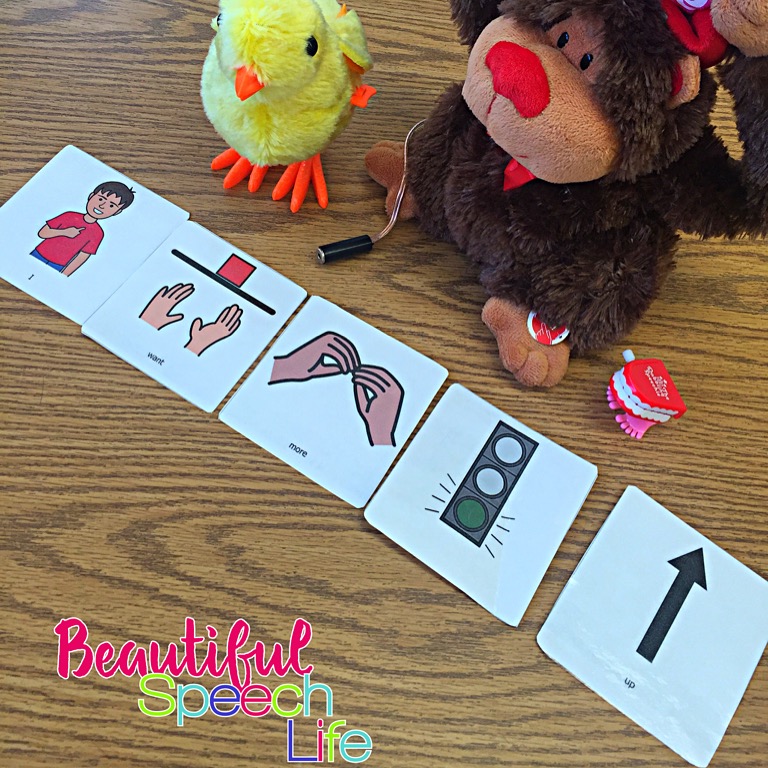
Core Vocabulary
What is it that worked? I believe it was a combination of timing, high interest activity and the Core Vocabulary visuals.
I am really looking forward to seeing what is the next step for my friend Benjamin.
So my point is…Patience Grasshopper.
We have to keep trying new approaches. I knew Benjamin was really visual and had tried some pictures before with little success. The Core Vocabulary words are immediately applicable and they can be used for fun, functional communication.
I really encourage you to try using DLM Core Vocabulary Words. As I learn more about this, I will definitely share the information with you all. I made a little cheat sheet and resource guide for you to help you get started. I know it can be a little overwhelming when you start out, so I streamlined it for you.
Until next time…SLP Like a Boss,
Anne
If you are looking for help with core boards, then download your condensed guide to core boards by clicking the green box. You’ll find links to popular AAC boards, along with tips to get started.



 No more FOUA (fear of using AAC).
 Hey there I’m Anne Page. I help heart centered SLPs and educators put the fun in functional communication.